


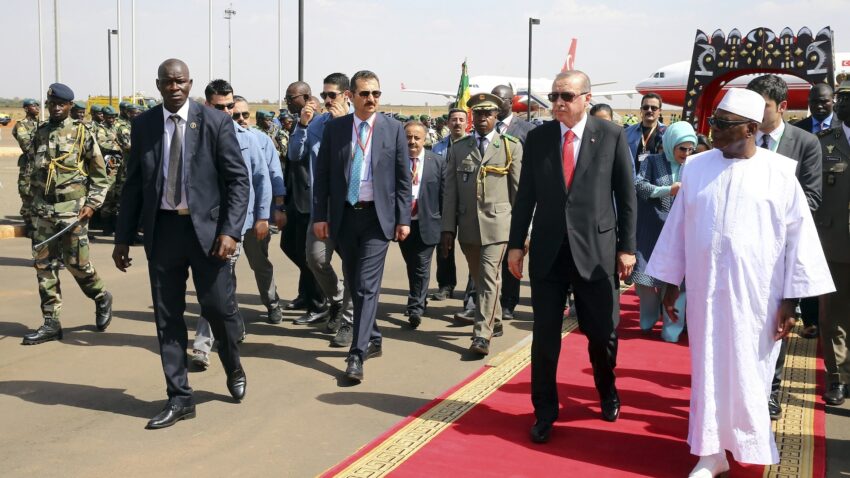
Turkish President Recep Tayyip Erdogan and Mali’s then-President Ibrahim Boubacar Keita walk at the airport in Bamako, Mali, March 2, 2018
Traditionally, Turkey’s attention toward Africa has been more focused on the part of the continent bordering the Mediterranean Sea, which from modern-day Egypt to Algeria were once parts of the Ottoman Empire. However, rapid geopolitical changes in the Sahel region have prompted Ankara’s growing engagement with this more distant part of Africa.
A series of coups in Niger, Mali and Burkina Faso since the early 2020s have led to France’s gradual military withdrawal from the region. And following Donald Trump’s return to the White House, Washington limited its political, military and, most importantly, humanitarian engagement with the Sahel. The resulting vacuum has been filled by other outside actors, particularly Russia with regard to the region’s ongoing security crisis, but also China with regard to mining projects and even Iran. Lately, however, it is Turkey that now features as a prominent partner in the Sahel states’ cooperation with outside powers.
The visit in 2018 by Turkish President Recep Tayyip Erdogan to Algeria, Mauritania, Senegal and Mali can be seen as the starting point of Ankara’s greater engagement with the Sahel region. Turkey has been careful in positioning itself as a power that seeks mutual benefit in bilateral relations with the Sahel countries, while highlighting the difference in its approach with that of France and other Western countries. Erdogan’s further visits in 2021 and 2022 to West African states demonstrated the consistency of his government’s engagement with the region.
A big part of Turkey’s outreach to the Sahel is based on providing humanitarian aid. For instance, in Burkina Faso, the Turkish Red Crescent, the Turkish Cooperation and Coordination Agency and The Maarif Foundation—a civil society educational organization—are actively working on advancing bilateral relations.
Turkey is even more actively engaged in Niger, whose importance to Ankara lies in its geographic proximity to Libya, where Turkey played a key role in the country’s civil war and continues to engage politically. Similar to its engagement with Mali and Burkina Faso, Turkey has been involved in numerous humanitarian programs in Niger, with cooperation in health care and water projects featuring prominently. Turkish firms have also been involved in infrastructure development, including the construction of an airport in Niger’s capital, Niamey.
The military coups in the Sahel since 2020 dramatically changed the geopolitical situation to Turkey’s advantage with regard to security cooperation. Ankara has skillfully tapped into the vacuum created by France’s subsequent withdrawal—at the demand of local governments—from most of the region, as well as Washington’s decision under former President Joe Biden to rescind defense cooperation with Burkina Faso, Niger, Mali and Chad.
The result has been sprawling military cooperation, most visibly in deals for one of the key products of Turkey’s defense industry: Bayraktar TB2 drones. Starting in 2022, Burkina Faso received several batches of TB2s as well as Akinci drones, with Mali and Niger following suit. In 2023 and 2024, Chad placed orders for Turkish-made Anka-S and Aksungur drones. Overall, Turkey has been Africa’s top supplier of drones, with 28 agreements inked since 2021. Chad and Burkina Faso have also bought Turkish armored vehicles, while Niger and Chad acquired Turkish planes in 2022 and 2023. The appeal of Turkish weapons is that they are cheaper than Western alternatives and as effective as what Russia and China have to offer.
The growing scope of military and security cooperation is further underscored by reports that Turkey has even established its first military base in the Sahel. Earlier this year, Military Africa reported that Chad and Turkey reached an agreement for Ankara to take control of a military base in Abeche that previously hosted French forces that withdrew after ties with the new authorities in Ndjamena deteriorated following the coup there. In July, Turkey also inked an agreement for military cooperation with Niger, with some reports suggesting it would train Nigerien troops to fight jihadist militants in the country.
The regional security outlook, which combines cross-border threats from extremists as well as internal challenges from separatists, particularly in Mali, will most likely only drive the Sahel’s states and Turkey closer, including cooperation in the private military sector. Another less discussed area of cooperation is in the region’s mining and natural resource sector, where the Sahel countries would welcome Turkish investments in the necessary infrastructure development. In 2024, for instance, Turkey and Niger signed a memorandum of understanding for cooperation in mining.
The relationship is also powered by the Sahel countries themselves, which seek greater diversification of their foreign partnerships. Excessive reliance on France and Western countries in general have driven popular distrust and been a constant source of tensions between the Sahel countries and these outside powers. Bolstering ties with Turkey provides the region’s countries with more room for maneuver—and, with it, leverage— in their foreign relations.
As such, the Sahel countries do not seek to replace France with Turkey, nor has Ankara sufficient resources to position itself as the most dominant power in the region. Yet what makes Turkey an attractive option not only for the Sahel states, but also for Ankara’s Western allies, is that it is a trusted security partner that can help battle extremism while also serving as a counterbalance to Russia, China and Iran in the region.
Turkey’s active engagement with the Sahel region also fits in neatly with Ankara’s positioning of itself as an Afro-Eurasian country. Turkey increasingly regards Africa as an area of economic opportunities, and as mentioned earlier, it has been actively pursuing stronger economic and political ties across the African continent. In the period between 2003 and 2022, trade between Turkey and the continent reached nearly $40 billion, while Turkish construction companies are involved in projects worth some $85 billion. These figures are still signficantly smaller than those for China, Russia or the U.S., but given Turkey’s smaller size and the fact that it is a late-comer, the progress is significant. Similarly, between 2002 and 2022, the number of Turkish embassies across the continent grew from 12 to 44, with several more planned to be unveiled in the near future to effectively cover all of Africa.
More broadly, this engagement is part of Ankara’s efforts to position itself as a key partner to the Global South, a geographically sprawling and politically heterogeneous area characterized by growing populations and economies—and as a result, increasing geopolitical clout. Like its African partners, Turkey has long called for major reform in global governance to make it more representative of the Global South.
As a result, Turkey’s role in Africa can be expected to increase, with the Sahel region likely to remain a focus of its expanding influence. Ankara will benefit in those efforts from the widening gaps between the region’s states and the Western powers that were traditionally the dominant outside powers. Turkey seeks to offer the Sahel a developmental approach that is very different from what the Western countries had offered for the region. Its model is based not only on mutually beneficial economic development without attaching political conditions to its investments, but also social development for the states of the region.
Emil Avdaliani is a professor of international relations at the European University in Tbilisi, Georgia, and a scholar of Silk Roads. He can be reached on Twitter/X at @emilavdaliani.
Source: https://www.worldpoliticsreview.com/turkey-sahel-mali-niger