


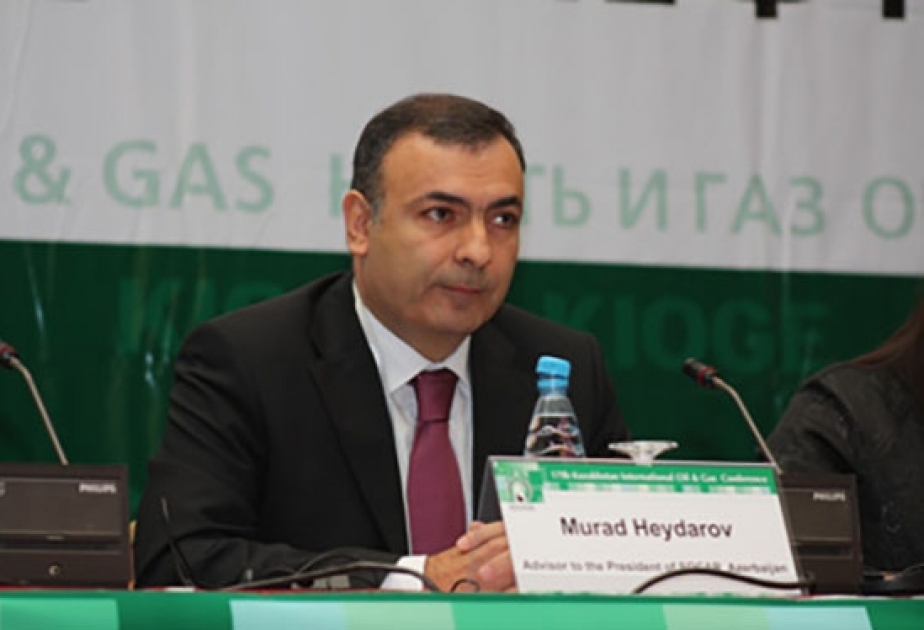
As the head of SOCAR Balkan noted, there is another area of work – expanding the company's commercial position in the Bulgarian petroleum products market.
„This is quite a challenging task, as competition is very fierce, given that LUKOIL operates an oil refinery here. However, certain opportunities exist. We are working on this, and we are seeing results. Therefore, expanding our position in the petroleum products market is one of our major areas of focus“, added Murad Heydarov.
On October 8, 2025, the Azerbaijani news agency Trend News Agency published a report under the headline:
„SOCAR Interested in Acquiring an Oil Refinery in Bulgaria“. The author of the article was Laman Zeynalova, a journalist closely following SOCAR's expansion in Southeastern Europe, including Bulgaria.
According to a „source familiar with the situation“ cited by Zeynalova, Azerbaijan's state oil company SOCAR has expressed interest in the Russian LUKOIL refinery in Bulgaria.
Notably, Zeynalova cites Bulgarian sources in her publication when discussing the Azerbaijani company's intentions. She writes:
„It's worth noting that, according to Bulgarian sources, SOCAR and the Turkish holding company „Cengiz“ have formed a consortium to acquire the LUKOIL refinery in Burgas.
Other bidders for this asset include the international trader Vitol, the Hungarian „MOL Group“, Kazakhstan's national oil company „KazMunayGas“, and the Turkish pension fund OYAK."
However, it is further rightly emphasized that “SOCAR and LUKOIL have not commented on this information in any way”.
In conclusion, we present a rather lengthy and meaningless statement from an anonymous source at „Trend News Agency“:
„SOCAR is implementing a long-term strategy of mutually beneficial cooperation with relevant government agencies and companies in Bulgaria in various areas, including gas supply, gas distribution, and expanding its position in the petroleum products market.
Naturally, from this perspective, LUKOIL's assets in Bulgaria are also of interest to the company. SOCAR has studied this issue and conducted the relevant consultations and negotiations“. (https://ru.trend.az/business/energy/4100801.html ).
In fact, the „Trend“ news agency first reported SOCAR's interest in the Burgas refinery on September 4, 2025. However, this news was published in the agency's paid section and was not publicly available. To be fair, the topic of SOCAR purchasing LUKOIL's assets in Bulgaria has been circulating in the media since 2023, but there is still no sign of a deal being finalized or even a clear official statement from the potential buyer.
Also on September 4, 2025, an exclusive interview with Murad Heydarov, head of SOCAR's regional office in the Balkans in Sofia, was published in the free and open access section of „Trend News Agency“. (https://ru.trend.az/business/energy/4087000.html ).
At the very end of the posted text is the following significant paragraph:
As the head of SOCAR Balkan noted, there is another area of work – expanding the company's commercial position in the Bulgarian petroleum products market.
„This is quite a challenging task, as competition is very fierce, given that LUKOIL operates an oil refinery here. However, certain opportunities exist. We are working on this, and we are seeing results. Therefore, expanding our position in the petroleum products market is one of our major areas of focus“, added Murad Heydarov.
On October 8, 2025, the news that SOCAR wanted to acquire „Neftochim“ - Burgas was already published in the public domain by the „Trend“ news agency.
This means that SOCAR has serious ambitions to expand its presence on the Bulgarian market beyond natural gas supplies, and one of the obstacles on this path is the competition of LUKOIL through its production facilities in Bulgaria – the Burgas refinery.
From the above publication it follows that SOCAR and LUKOIL are remaining silent on the issue of „Neftochim“ - Burgas, and the news concerning the interest of the State Oil Company of the Azerbaijan Republic in acquiring the refinery has been reported in the form of quotations from the Bulgarian media..
This may suggest SOCAR's interest, but even if it has been expressed to LUKOIL, nothing is certain yet. Moreover, even if LUKOIL agrees in principle, there are so many details, complexities, and nuances that it's unlikely we should expect any definitive statements until at least some of them are clarified.
A separate issue is that SOCAR has a remarkable oil refinery in Izmir, S.T.A.R., which can process both BRENT and URALS crude oil. The refinery, which cost was $7 billion to build, has been operating since October 2018. The issue whether it is profitable for SOCAR to incur the costs of acquiring Neftokhim-Burgas or not, could have an answer only after a detailed feasibility study takes place.
Regarding SOCAR's S.T.A.R. oil refinery, it's worth noting that its reconstruction, which began in September 2024 (https://ru.trend.az/business/energy/3948864.html ), has led to a halving of Turkey's purchases of Russian oil. (This was reported by the Trend news agency, citing analysts from the global economic intelligence agency „Kpler“ (https://www.kpler.com/ ).
At that time, Turkey was one of the top three buyers of Russian oil, but in August 2024, its purchases fell to 200,000 barrels per day, down from 400,000–450,000 barrels in early summer 2024.
„Kpler“ then speculated that the decline was due to scheduled maintenance at the S.T.A.R. refinery, which began on September 5, 2024, and was scheduled to continue until early November.
„This refinery consumes approximately 45% of all Russian oil supplied to the Turkish market. Due to maintenance work at the refinery, Russian oil supplies to the Turkish market have decreased“, „Kpler“ concluded at the time.
It is worth noting that the oil refining capacity at the S.T.A.R. refinery in August 2024 was 200 thousand barrels per day, and after the repairs it was expected to increase by 2.5%.
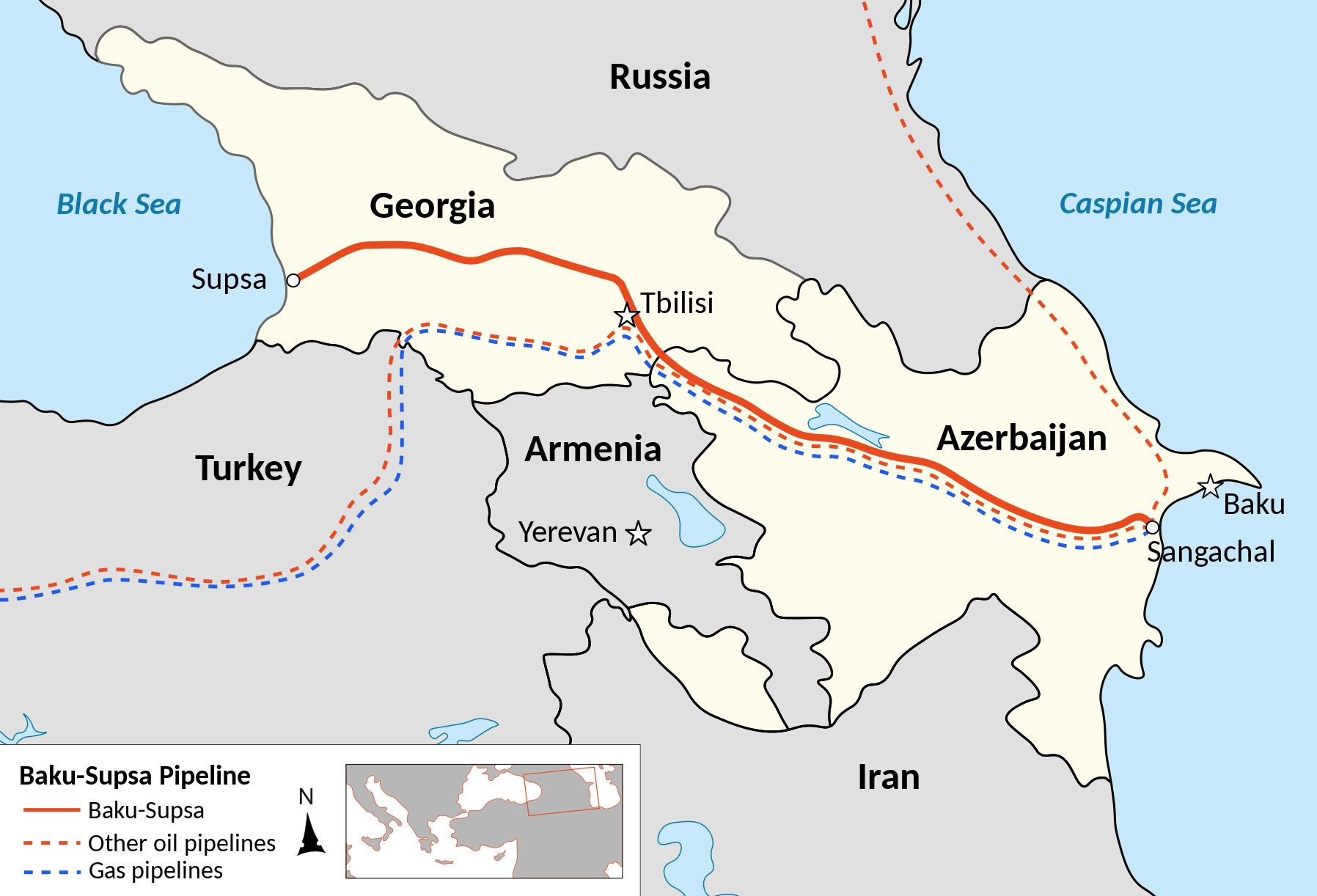
SOCAR would undoubtedly have one major advantage: crude oil, whether Azerbaijani or Kazakh (the point of view of KazMunayGas, Kazakhstan's state-owned company, should be the same), would be easily delivered to the Black Sea coast via the Baku-Supsa pipeline. Supsa is a port on Georgia's Black Sea coast with an oil terminal. The pipeline is owned by British Petroleum (BP), a company that operates several fields in Azerbaijan and is extremely close to the authorities in Baku.
But that's where the obvious advantages end. What follows are precise calculations that can't be devised off the cuff. There's also something else:
If we're talking about the so-called "ruling class" in our country, as defined by Gaetano Mosca, or more precisely, the most influential elites within it, then it seems to me that initially no one in Bulgaria would have been thrilled about SOCAR or „KazMunayGas“ buying Neftochim.
Such a deal could lead to a sharp “exposure” of the activities around „Neftochim“, it would exclude various privileged groups from various “schemes” and, in general, it is going to destroy the existing “cosmic corruption order”.
From the perspective of the „minor planets“ and „asteroids“ that take part in the shaping of the „cosmic corruption order“, it would be far better if some obscure international private company emerged to maintain the „status quo ante“. How it all started to happen in the beginning ...
Now, with the latest developments – concessions and delays from the side of the United States and the United Kingdom, things are taking a completely different turn.
Meanwhile, on November 15, 2025, against the background of absolutely monotonous statements from the Bulgarian, Azerbaijani and Russian media, an interesting speculation (there is no other way to describe it) emerged about the interest and intervention of the Chevron company in the battles surrounding the fate of LUKOIL assets in Bulgaria.
An article by Elnur Mamedov titled „SOCAR's Battle with the Americans in Bulgaria“ appeared on the Azerbaijani website „Haqqin“. In addition to repeating a number of points, which circulate in the media since August 2025, it also states the following:
„However, potential competition from „Chevron“ corporation emerged as an unexpected factor. The first reports of this American company's interest appeared in November 2025, and, notably, they originated from Russian media sources. „Chevron“ neither confirms nor denies these reports, but the energy giant's increased activity appears entirely logical.
The company is a key shareholder in oil projects in Kazakhstan, holding a 50 percent stake in the Tengiz project and an 18 percent stake in the Karachaganak project. Against this backdrop, the recent meeting in Washington between Kazakh President Kassym-Jomart Tokayev and Chevron's management is indicative, following which the parties agreed to strengthen cooperation.
It should be noted that, between 2024 and 2025, oil from Kazakhstan, along with supplies from Azerbaijan and Iraq, was the primary feedstock for the Bulgarian refinery. „Chevron“ has extensive refining infrastructure, operating five major refineries in the United States.
Logistically, delivering crude to Burgas could prove more costly for „Chevron“ than for „Cengiz-SOCAR“. However, much will depend on the political decisions of the US and the Bulgarian government. Washington is already actively using Greek ports, particularly the terminal in Alexandroupoli, which could also be used to supply oil and petroleum products to Bulgaria, which owns a 20 percent stake in the Greek terminal.“. ( https://haqqin.az/news/366179 ).
It should be noted that the „Haqqin“ website is not listed as an official Azerbaijani media outlet, but Azerbaijani officials generally do not hesitate to cite its publications. We are not providing the full text of the article here, as its content has been repeated and retold many times in Bulgarian media, and from there, in Azerbaijani media.
However, two points are notable. First, the American company „Chevron“, the only one still operating in Russia, is listed as a competitor of SOCAR. (By the way, „Chevron“ is likely once again pressuring Trump to resolve the issue of resuming work on the Sakhalin oil production concession).
The second notable issue is that „Chevron“ has similar logistics routes and considerations to „Cengiz-SOCAR“. The Tengiz field is located on the Caspian Sea coast, and oil from it is transported either via the „Tengiz-Novorossiysk“ pipeline or by tankers to Baku, and from there, primarily via the „Baku-Tbilisi-Ceyhan“ pipeline. Bulgaria, thankfully, cannot import oil through the port of Novorossiysk, but for Kazakh oil transported to Baku, the „Baku-Supsa“ pipeline serves exactly the same function as it does for „Cengiz-SOCAR“.
In this sense, if there is any truth to Haqqin's statement, Chevron's logistical considerations are exactly the same as those of „Cengiz-SOCAR“.
In this sense, the „Haqqin“ website's assertion that „logistically, delivering crude oil to Burgas could be more expensive for „Chevron“ than for „Cengiz-SOCAR“ is completely meaningless. They are one and the same route.
In any case, this publication once again confirms that both SOCAR and LUKOIL are remaining silent on this issue, unlike Turkish businessman Cengiz, who has been sending various signals in recent days, but they obviously do not concern SOCAR and especially not LUKOIL.
Thus, it should be noted once again that, as of the close of business on November 18, 2025, there was no official interest on the part of SOCAR or „KazMunayGas“ in acquiring LUKOIL's assets in „Neftochim“ (Burgas). There were numerous discussions, but they were along the lines of „this one told me, that one assured me“. Therefore, on first hand it's not at all certain that SOCAR has given up, and on the second hand, it's entirely possible that … they never submitted a bid at all.