


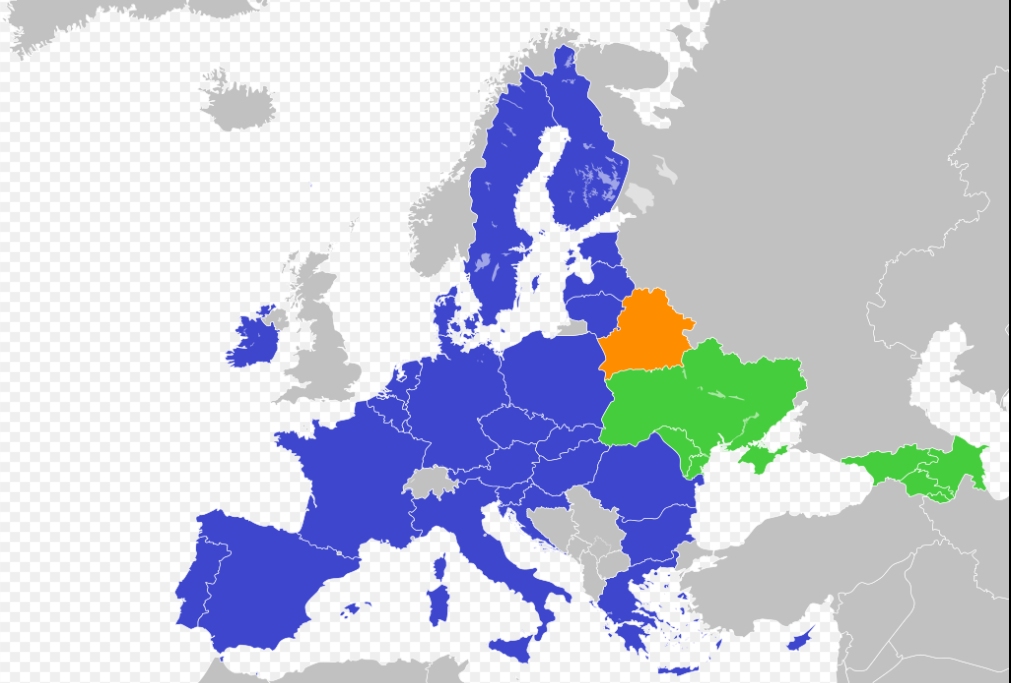
Map of the countries of the “Euronest” Parliamentary Assembly. In blue are the EU member states; in green are the countries that are not members of the EU; in orange is the country that was removed from “Euronest” – Belarus. The initiator of the creation of “Euronest” is the European Commission, which launched this idea in 2011, as part of the so-called “Eastern Partnership”.
I have repeatedly criticized large groups of MEPs in the European Parliament for their, to put it mildly, inadequate resolutions on the issues of the South Caucasus and in particular on the relations between Azerbaijan and Armenia. Indeed, usually the positive things in the EU-South Caucasus and EU-Azerbaijan relations come from the European Commission.
This time, I am happy to report something positive coming from the European Parliament, in particular from the “EuroNest” Parliamentary Assembly, which brings together parliamentarians from the European Parliament and the parliaments of Azerbaijan, Armenia, Georgia, Moldova and Ukraine. The “EuroNest” Parliamentary Assembly is an inter-parliamentary forum for closer political and economic ties with the European Union.
The initiator of the creation of “Euronest” was the European Commission, which launched this idea in 2011 as part of the so-called “Eastern Partnership”. From the very beginning, Belarus was excluded from the partnership list, as it refused to take any (even formal and/or hypocritical) measures in connection with the huge scandal surrounding the country’s 2010 elections and the corresponding assessment of them by the Organization for Security and Cooperation in Europe (OSCE). It has been repeatedly declared that Belarus is welcomed back to “Euronest”, as long as it makes efforts to hold fairer elections. For now, however, there are no signs in Minsk that they have set themselves the goal of restoring interparliamentary cooperation with the EU and the other Euronest countries.
Exactly the opposite is true for Azerbaijan. In 2015, the Republic of Azerbaijan was criticized by European Union institutions, most notably the European Parliament, in connection with various actions of the Azerbaijani government that were described as restricting or violating human rights. Azerbaijan withdrew from interparliamentary cooperation, but after a year, with the active engagement of both sides, Baku's participation in “Euronest” was restored. Azerbaijan took concrete steps in response to European criticism, and the European institutions significantly softened their tone, taking into account what the other side has done.
Unlike Belarus, Azerbaijan neither throws itself into the arms of Russia nor prioritizes China over the EU. On the contrary, Baku is one of the places where the so-called “soft power” of the EU and Europe as a whole has a tangible impact and the authorities, regardless of whether they are offended by a given criticism or not, always take the necessary measures stemming from it. In the case of Euronest membership, it was restored exactly one year later – in September 2016.
It is worth noting that at that time, Azerbaijan did not have its current weight as a major supplier of natural gas to Southeast Europe. At that time, even the Trans-Anatolian Gas Pipeline was still under construction and far from completion. In these debates, both sides proceeded from their strategies and from considerations of principle, which is why understanding was achieved.
According to 2017 data, the total population of the Euronest member states (excluding the EU member states and Belarus) amounted to 61,927,521 people.
The Euronest Parliamentary Assembly is composed of 60 MEPs and ten members from each parliament of the five partner countries. The plenary sessions are chaired by two co-presidents – one from the European Parliament and one from the partner parliaments. The Euronest Bureau is composed of two co-presidents and eight vice-presidents – four from the European Parliament and four from the partner parliaments. There are four committees and three working groups.
The Euronest plenary meetings are convened once a year. The meeting locations rotate between the Eastern Partnership countries and one of the European Parliament’s places of work – Brussels, Strasbourg or Luxembourg. The committees meet twice a year, and the working groups meet according to an agreed schedule.
The news is good, once because Euronest's assessment of the importance of the Southern Gas Corridor is absolutely correct, and secondly, because a clear proposal for investment in a gas pipeline is emerging from the Parliamentary Assembly, in which there is a significant presence of European deputies.
The latter is at odds with the almost fanatical position of European financial institutions (the European Investment Bank and the European Bank for Reconstruction and Development) not to finance projects related in any way to fossil fuels. This position is almost crazy, because both natural gas and oil are not only fuels, but also raw materials for the production of all kinds of products.
Moreover, when financing infrastructure projects that guarantee a good return on investment and a secure return on loans is refused, the latter is nothing more than an invitation to seek other sources of financing, which most often boil down to some form of cooperation with the Celestial Empire - China. This is not an example of either political or financial prudence.
In addition, there has long been work on using gas pipelines to transport hydrogen, including hydrogen produced by electrolysis with electricity from renewable sources – the so-called “green hydrogen”. (There are also “brown” and “pink” hydrogen and many other types of hydrogen, classified according to their production method).
So, let's congratulate each other this time, instead of getting angry at abstract ideas and general talks.
See the initial information about the Euronest resolution here:
https://teodordetchev.blog.bg